| Open Wheel Invasion: has NASCAR’s quest for dominance come at the expense of its Stock Car roots? by Jim Hart, Jan 29, 2008 | |||||||||||||||||||||||
|
They're coming to NASCAR in surprising numbers and surprising nationalities. For 50 years, the domain of NASCAR drivers had been All-American (mostly southern) good old boys who proved their metal on the local NASCAR sanctioned short track ovals. But things began to change as NASCAR used a fledging cable sports channel (ESPN) to broadcast their races in the 80's and slowly gained an audience beyond the southern fan who packed up their trucks and tailgated each weekend at the track. By the 90's, NASCAR began to show themselves as a strong competitor to the once dominate CART Champ Car Series (called CART Indy Car World Series at that time). Amid a strong marketing campaign of both its series and its drivers, two significant events happened to sway the balance for NASCAR to become America's #1 watched form of motor racing, and both events involved one man with an open wheel heritage, Tony George. 1) Indianapolis Motor Speedway shocked Indy fans by announcing a 2nd race for NASCAR to run at the famed Brickyard staring in 1994, 2) In 1996 Tony George split open wheel racing into two rival series with his Indy Racing League. At the time of the split, CART was enjoying its best TV ratings and track attendance in its history. But NASCAR rode the wave of expansion into new markets outside of the south by increasing its schedule to 36 races and removing races from southern tracks. Over the next 10 years, Nascar's TV ratings would triple from Neilson ratings of 1's and 2's to 4's and 5's while CART would see it's usual 3+ ratings fall to the 2's by the end of the decade and down below 1 for most of their races today. But with growth and expansion, comes attention. The migration from NASCAR out of the south (especially into the Brickyard) brought drivers like Jeff Gordon, J.J. Yeley, Kurt Busch, Kasey Kahne, Casey Mears and others away from their Open Wheel roots and into NASCAR instead of CART or the IRL. As NASCAR surpassed CART in both television and attendance figures in the late 90's, current CART and IRL drivers and even teams began looking at NASCAR as a viable new home. In 2000, PPI Motorsports shocked the Open Wheel family by announcing their full time entry into NASCAR and eventual departure from the CART Champ Car series at the end of the 2000 season. They took popular driver Scott Pruett (10 yr veteran with 145 starts and two wins) with them. The next year Chip Ganassi Racing (4 time CART champions from 95-98) bought 80% ownership into the Felix Sabates NASCAR team while continuing his open wheel operations.
As for drivers, the migration of CART Champ Car and IRL Indy Car drivers also began in the late 90's and early 2000's. Tony Stewart, who dreamed of winning the Indy 500, raced first in the IRL in 97 & 98. Stewart won the 1997 title and nearly won the Indy 500, leading 64 laps before falling back to 5th. Stewart would switch to NASCAR’s Cup division in 1999. Robby Gordon, after racing in CART from 1992-1999 with two wins, would be next to switch starting with a full Cup season in 2000. Casey Mears ran in the CART Indy Lights series from 1996-2000 and would run for Rahal Racing to finish the 2001 CART season. In 2002, Mears left open wheel to run a full year in the Busch series before switching to the Cup series full time in 2003 running for Chip Ganassi. As for foreign drivers and Formula 1 experience, many forget that Juan Montoya was preceded by Christian Fittipaldi from Brazil who raced in Formula 1 (92-94) and then the CART Champ Cars (95-00) with two wins. Fittipaldi left to drive in the Busch series for 01 & 02 before making his Cup debut at Phoenix in 2002 and running the #43 and #44 cars in 2003. His NASCAR foray was not successful however, and he switched back to Champ Car in 2004 before finding a comfortable home in Sports Car racing. Perhaps because of Fittipaldi’s struggles (as well as Scott Pruett’s) the next few years would be relatively quiet.
The quiet was simply the calm before the
storm as the next two years would bring an explosion of open wheel
attention and the ultimate transition of open wheel’s very best into the
NASCAR ranks. This latest
breed of top ranked open wheeler’s would include AJ Allmendinger,
who was billed as the next great open wheel savior after winning two
championships in Champ Car's ladder series before winning the Champ Car
Rookie of the Year in 2004 and then 5 Champ Car victories in 2006. A
lucrative deal from Red Bull to driver a Toyota in the 2007 Cup season
stunned Champ Car fans and series official alike. As big a story as
Allmendinger was, Juan Montoya from
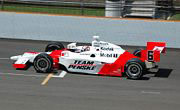
Following in the footsteps of Allmendinger and Montoya, comes this years departure from the IRL of series champions Sam Hornish Jr and Dario Franchitti. Hornish, who has three IRL Championships and an Indy 500 victory will drive for Penske while Franchitti who has one IRL Championship, an Indy 500 victory, and a 2nd place Champ Car season finish (on a tiebreak loss to Juan Montoya), will drive for Chip Ganassi. Joining in the fun for 2008 are two more open wheel veterans from Canada. Jacques Villenueve, who has an even better resume than Montoya, comes in sporting an Indy 500 victory (1995), a CART Champ Car Championship (1995) and a Formula 1 Championship (1997). The other Canadian is Patrick Carpentier who won the Atlantic Championship on his way to becoming a decade long Champ Car veteran (96-04) with five wins. Carpentier also ran one season in the IRL in 2005 for a small team.
Until last year, Daytona hasn’t seen Indy champions since the Mario Andretti and A.J. Foyt days of the 60’s and 70’s and only then in single race appearances. But with the new crop of open wheel entrants, this year’s full time NASCAR lineup now includes: 4 - Indy 500 Champions (Montoya, Hornish,
Franchitti, Villenueve) While some enjoy the international flavor and attention, some must be wondering if NASCAR has lost its identity by diminishing its short track roots. Even worse for NASCAR is that most are coming directly into the Cup division without at least one or two seasons of lower level training in its Craftsman Truck Series or Nationwide Series. With ten drivers coming directly from open wheel's top ranks, plus Jeff Gordon & Kurt Busch from open wheel midgets and sprint cars, and the addition of Michael McDowell from sports car racing and a few starts from Boris Said from sports cars, this year’s grid could have 33% of its field occupied by drivers who came up from outside NASCAR's traditional path. This is a statistic that doesn’t bode well for many young drivers trying to work their way up the Stock Car ladder. The question of course is will this hurt or help NASCAR as it moves forward? In 2007, NASCAR showed some vulnerability as most of its tracks had visibly empty seats and all but a few races saw TV ratings drop from 2006. Maybe this is just a coincidence, or maybe it's a sign that NASCAR is betraying its diehard fan base who also witnessed the inclusion of Toyota in 2006, another foreign entity with traditional open wheel roots. Perhaps now is the time for NASCAR to take a step back and look at the long term effects of this invasion and ask themselves, “Is this the direction our fan base wants?” Or are they simply counting on the open wheel fan base to outgrow any lost fans from the good ole days? Only time will tell. To summarize the current invasion in this year’s grid, the following is the list of ten drivers and their accomplishments from either the IRL, Champ Car, or Formula 1 in the order of their NASCAR appearance:
|